
455 Defendants Charged in Connection with Over $6.5 Billion in Alleged Health Care Fraud
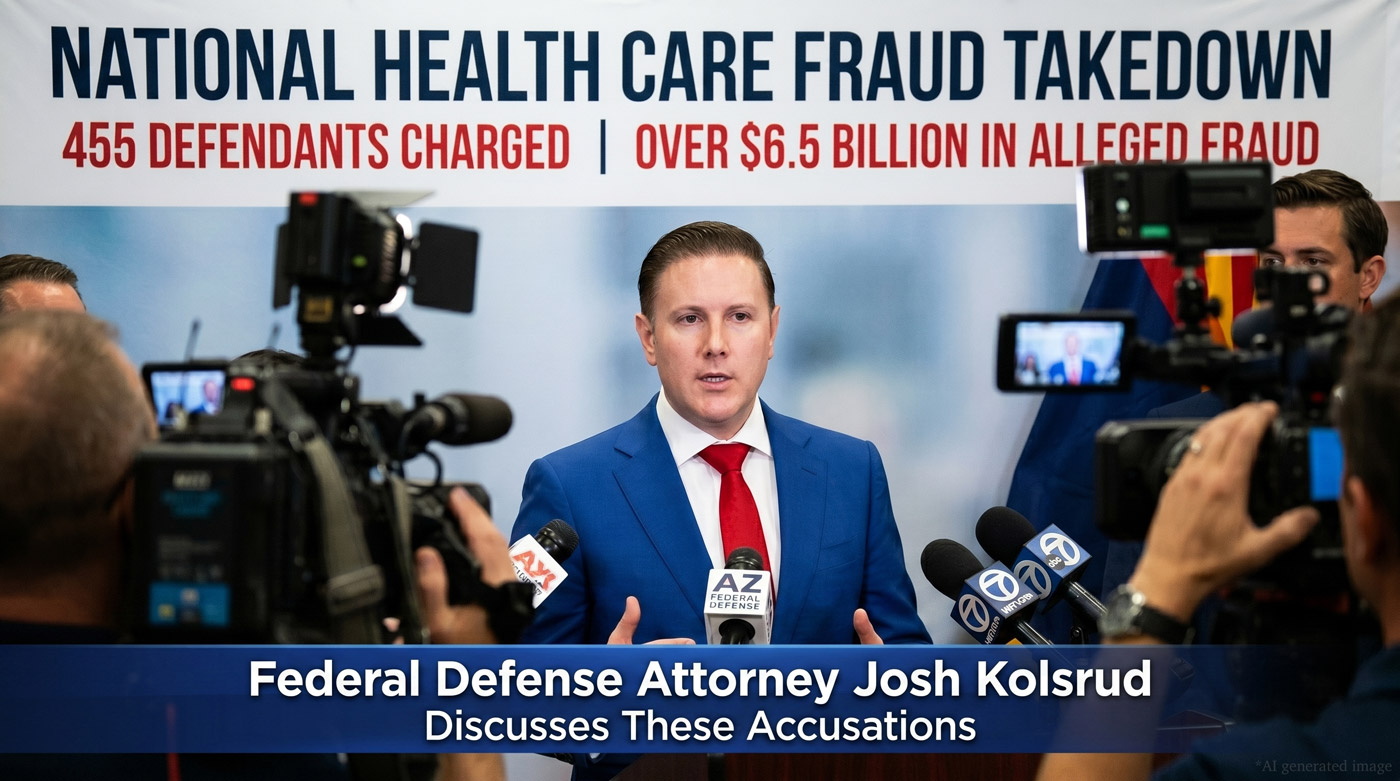
On June 23, 2026, the U.S. Department of Justice announced the 2026 National Health Care Fraud Takedown, reporting charges against 455 defendants in alleged health care fraud and opioid abuse schemes involving more than $6.5 billion in false claims.
The DOJ stated that 90 doctors and other licensed medical professionals were among those charged. These are allegations, not convictions. Every person charged in a federal criminal case is presumed innocent unless the government proves guilt beyond a reasonable doubt.
Quick Facts About This Article
- The DOJ reported 455 defendants charged in alleged health care fraud and opioid abuse schemes involving more than $6.5 billion in false claims.
- The District of Arizona was included in the takedown, including allegations tied to wound care allografts and behavioral health services.
- Allegations are not convictions. The government must prove guilt beyond a reasonable doubt.
- Health care fraud cases often involve billing data, medical records, patient files, contracts, bank records, text messages, emails, and witness statements.
- A coding error or documentation problem is not the same as criminal fraud.
- Kickback cases often turn on intent, contracts, payment structure, fair market value, and referral evidence.
- Insurance fraud and healthcare fraud cases can overlap when medical billing, reimbursement, false statements, or claim submissions are involved.
- Do not speak with federal agents or alter records before getting legal advice.
- Defense attorney Josh Kolsrud brings former federal prosecutor experience and close to two decades of criminal law experience to clients facing serious fraud allegations.
The announcement is especially important for Arizona because the District of Arizona was included in the national enforcement effort. The DOJ identified Arizona-related allegations involving wound care allografts and behavioral health services.
One Arizona matter involved an alleged nationwide kickback and health care fraud scheme tied to amniotic wound allografts. Another involved alleged fraudulent behavioral health claims that the DOJ said primarily targeted Native Americans struggling with substance abuse.
For physicians, clinic owners, behavioral health operators, marketers, billing companies, executives, and licensed professionals in Arizona, the takedown shows how quickly a billing dispute can become a federal criminal investigation.
Defense attorney Josh Kolsrud represents clients accused of health care fraud, insurance fraud, and related white collar offenses. His background as a former federal prosecutor gives clients a valuable perspective when the government is reviewing billing data, medical records, contracts, bank records, and witness statements.
DOJ Health Care Fraud Takedown: Charges, Agencies, and Alleged Schemes
The DOJ described the national takedown as a coordinated federal, state, and international enforcement action. According to the DOJ’s health care fraud takedown release, the cases were filed across 56 federal districts and 45 states and territories. The DOJ also reported that 50 state Medicaid Fraud Control Units participated, which it described as the largest number in the Department’s takedown history.
The enforcement action went beyond criminal charges. The DOJ reported seizures of more than $182 million in cash, luxury vehicles, jewelry, and other assets. It also stated that CMS suspended 1,079 providers and revoked billing privileges for 1,403 providers.
Those details matter because a federal health care fraud case may affect far more than a person’s freedom. A provider may also face billing suspensions, exclusion from federal health care programs, licensing problems, asset seizure, civil claims, and damage to a professional reputation.
The DOJ announcement identified several categories of alleged schemes, including wound care allograft billing, behavioral health billing, hospice fraud, unnecessary cardiovascular testing, Medicaid fraud, and controlled substance cases. Federal prosecutors often use broad enforcement actions like this to send a warning to industries that rely on government reimbursement. In health care, that includes Medicare, Medicaid, AHCCCS related billing, TRICARE, federal workers’ compensation, and other public benefit programs.
Josh Kolsrud’s experience is relevant because these cases are rarely simple. Kolsrud Law Offices discusses many of these issues in its page on Arizona healthcare fraud federal defense. A federal investigation may involve HHS-OIG agents, FBI agents, DEA investigators, CMS auditors, IRS Criminal Investigation, state Medicaid fraud investigators, and prosecutors from the U.S. Attorney’s Office.
As a former federal prosecutor who now defends people accused of federal crimes, Josh knows how agencies build fraud cases and how early defense work can shape the outcome.
Why the Takedown Matters for Arizona Providers and Behavioral Health Businesses
Arizona was specifically named in the DOJ announcement. In the wound care section, the DOJ stated that a vice president of sales for a company that sold allografts was charged in the District of Arizona as part of an alleged nationwide illegal kickback and health care fraud scheme. The DOJ alleged that Medicare was billed more than $4 billion for that company’s allografts from approximately December 2021 through June 2024, resulting in more than $2 billion in payments.
The behavioral health allegations also have a direct Arizona connection. The DOJ stated that a defendant in the District of Arizona was charged with submitting $44 million in fraudulent claims for behavioral services. The release alleged that the defendant billed for services never provided and falsified therapy notes to make it appear that patients attended sessions. The DOJ also stated that the alleged scheme primarily targeted Native Americans struggling with substance abuse.
Those allegations touch areas that Arizona prosecutors and federal agencies have been watching closely:
- Substance abuse treatment
- Sober living arrangements
- Behavioral health billing
- Medicaid-funded services
- Native American communities
- Patient transportation
- Counseling notes
- Referral relationships
Providers in Phoenix, Scottsdale, Mesa, Tempe, Chandler, Glendale, Flagstaff, Tucson, and rural Arizona may face federal scrutiny even when their business operates only inside Arizona.
Arizona fraud law may also come into play. In state court, prosecutors sometimes rely on A.R.S. § 13-2310 fraudulent schemes and practices when they believe a person used a scheme to obtain a benefit through false pretenses. In federal court, the government may use federal fraud statutes instead. Defense attorney Josh Kolsrud knows which system applies, which agency is involved, and how the state and federal issues overlap.
How Federal Health Care Fraud Allegations Usually Start
Many federal health care fraud investigations begin long before anyone is arrested. A provider may receive an audit letter, a subpoena, a civil investigative demand, a request for patient records, or a visit from agents. In other cases, the investigation starts with billing data. Federal agencies compare providers against peers, look for billing spikes, review unusual procedure codes, and study patterns that appear inconsistent with patient needs or staff capacity.
A data pattern does not always mean fraud occurred. A clinic may bill more than nearby providers because it treats a different patient population, offers specialized services, has extended hours, or receives referrals from hospitals and community organizations. A physician may use a higher-level code because patients are medically fragile. A behavioral health provider may have high volume because it operates multiple locations. The defense must bring context to the data.
For example: Consider a Phoenix behavioral health clinic accused of billing for therapy sessions that patients did not attend. The government may rely on claims data, therapy notes, patient interviews, text messages, sign-in sheets, and staff schedules. Josh Kolsrud would look at whether the records are complete, whether the government interviewed the right people, whether the patients’ memories are reliable, whether transportation records support attendance, and whether any errors were clerical rather than criminal.
Insurance-related cases can raise similar issues. A medical provider, adjuster, clinic owner, or business executive accused of insurance fraud may face allegations about false claims, inflated losses, staged events, or improper billing. Josh Kolsrud’s defense work in insurance fraud and healthcare fraud cases allows him to compare the government’s theory against real records, industry practices, witness credibility, and the client’s actual intent.
Contact us today to schedule a
FREE CONSULTATION and learn
how we can help you.
Federal Charges and Penalties in Health Care Fraud Cases
The main federal health care fraud law is the federal health care fraud statute, 18 U.S.C. § 1347. In general terms, it applies when a person knowingly and willfully executes, or attempts to execute, a scheme to defraud a health care benefit program or obtain money from that program through false or fraudulent pretenses. A conviction can carry up to 10 years in prison, up to 20 years if serious bodily injury results, and any term of years or life if death results.
Conspiracy charges are also common. Under the federal attempt and conspiracy statute, 18 U.S.C. § 1349, a person who attempts or conspires to commit certain fraud offenses can face the same penalties as the underlying offense. That is why someone who did not personally submit every claim may still be charged if prosecutors believe the person joined an unlawful agreement.
Kickback allegations can fall under the federal Anti-Kickback Statute, 42 U.S.C. § 1320a-7b. This law can apply when someone knowingly and willfully offers, pays, solicits, or receives remuneration to induce referrals or orders involving services paid by a federal health care program. These cases often turn on contracts, referral patterns, fair market value, intent, and whether an exception or safe harbor may apply.
Civil exposure may also arise under the civil False Claims Act, 31 U.S.C. § 3729. A person or business may face repayment demands, civil penalties, treble damages, settlement pressure, and exclusion risk even when no criminal conviction has occurred. In related insurance matters, the possible state-level impact is explained in Kolsrud Law Offices’ page on penalties for insurance fraud in Arizona.
| Charge or Issue | Law or Authority | Possible Consequences |
| Health care fraud | 18 U.S.C. § 1347 | Up to 10 years in prison, up to 20 years if serious bodily injury results, and any term of years or life if death results. Restitution, fines, and forfeiture may also apply. |
| Attempt or conspiracy | 18 U.S.C. § 1349 | The same penalty range as the underlying fraud offense that was allegedly attempted or agreed upon. |
| Illegal kickbacks | 42 U.S.C. § 1320a-7b | Felony exposure, imprisonment, criminal fines, civil penalties, and possible exclusion from federal health care programs. |
| False claims | 31 U.S.C. § 3729 | Civil penalties, treble damages, repayment demands, settlement exposure, and possible parallel criminal review. |
| Insurance fraud | 18 U.S.C. § 1033 or Arizona fraud statutes, depending on the case | Possible prison time, fines, restitution, probation, professional discipline, and licensing consequences. |
| Provider and licensing action | CMS, HHS-OIG, DEA, AHCCCS, and licensing boards | Billing suspension, payment holds, exclusion, DEA registration action, license discipline, payer termination, and reputational harm. |
Josh Kolsrud’s role in the penalties stage is not limited to arguing for leniency after charges are filed. Early defense work may affect the alleged loss amount, the number of claims at issue, whether services were medically necessary, whether a client had criminal intent, and whether prosecutors can prove the charged offense at all. In federal fraud cases, those issues can change the entire direction of the case.
Defense Strategies Josh Kolsrud May Use in Health Care Fraud and Insurance Fraud Cases
A strong defense starts by refusing to treat the government’s spreadsheet as the whole story. Claim data may show billing volume, dates, codes, and reimbursement amounts, but it does not always show patient need, staff workload, payer guidance, medical judgment, software errors, or whether the accused person acted in good faith. Josh Kolsrud reviews both the evidence and the assumptions behind the evidence.
Because Josh spent many years working as a federal prosecutor, he knows how prosecutors evaluate fraud allegations before and after charges are filed. That background helps him identify pressure points in health care fraud and insurance fraud investigations. The defense may focus on intent, witness statements, medical records, compliance practices, contracts, payment structure, search issues, or weaknesses in the loss calculation.
Common defense strategies may include:
- Lack of criminal intent or good-faith billing. The government must prove more than a mistake. Coding errors, staff miscommunication, unclear payer rules, or poor documentation may support a defense that the accused did not knowingly and willfully commit fraud.
- Medical necessity and professional judgment. In health care cases, prosecutors may claim that services were not needed. The defense may use records, experts, treatment history, and patient condition to show that services were medically justified.
- Challenge to billing data and loss amount. Federal agencies often rely on large data sets. Josh Kolsrud may challenge whether the sample is fair, whether legitimate claims were included in the alleged loss, and whether the government confused billing volume with fraud.
- Lawful business arrangement or no kickback intent. Marketing, employment, consulting, management, and referral-related agreements require close review. The defense may examine fair market value, written contracts, actual services performed, and whether the client knew the arrangement was unlawful.
- Unlawful search and seizure. If agents searched a clinic, home, storage space, phone, or computer system, the defense may review whether the warrant was valid, whether agents exceeded its scope, and whether privileged materials were improperly taken.
- Miranda and interview issues. Statements made during an investigation can become a major part of the government’s case. The defense may examine whether the client was in custody, whether rights were violated, and whether statements were voluntary and accurate.
- Witness credibility problems. Fraud cases often rely on former employees, cooperating witnesses, patients, marketers, or business partners. The defense may test bias, inconsistent statements, financial motives, memory problems, and whether the witness is trying to reduce personal exposure.
A second example helps show why these defenses matter. Suppose a Scottsdale wound care provider is accused of using a product too often and receiving improper benefits from a sales company. The government may claim that high reimbursement rates prove fraud. The defense may respond that the provider relied on clinical judgment, believed the product was covered, had no hidden kickback agreement, and did not know that another party was violating the law.
FAQs About Health Care Fraud and Insurance Fraud Defense in Arizona
Does the DOJ takedown mean every person charged will be convicted?
No. The DOJ announcement describes allegations. A charge is not proof. Federal prosecutors must prove each element of the offense beyond a reasonable doubt. Some cases may result in dismissal, reduced charges, civil resolution, plea agreement, trial, acquittal, or another outcome based on the facts.
Can a billing mistake become a criminal case?
A billing mistake alone should not be treated as fraud. Federal prosecutors usually focus on whether the person acted knowingly and willfully. That said, repeated billing errors, ignored warnings, false records, kickbacks, or efforts to hide conduct can increase risk. Josh Kolsrud reviews whether the case is truly fraud or a dispute about coding, documentation, medical necessity, or payer rules.
What makes Arizona behavioral health cases different?
Arizona has seen close attention on behavioral health, substance abuse treatment, sober living, AHCCCS-related billing, and services involving vulnerable communities. These cases may involve patient attendance, therapy notes, transportation records, housing arrangements, referral sources, and whether services were actually provided. The District of Arizona’s inclusion in the DOJ takedown shows that federal agencies are watching this space.
Can I be charged even if I did not personally submit the claim?
Possibly. In some cases, prosecutors use conspiracy, aiding and abetting, or causing-false-claims theories. A clinic owner, manager, marketer, biller, medical director, or sales representative may be accused even if another person submitted the claim. The defense may focus on what the client knew, what role the client actually played, and whether there was any agreement to commit fraud.
How do kickback allegations arise in health care cases?
Kickback allegations often involve payments tied to referrals, patient leads, product orders, prescriptions, lab testing, durable medical equipment, wound care products, or behavioral health services. Not every payment arrangement is unlawful. The defense must review contracts, fair market value, actual work performed, referral patterns, safe harbor issues, and intent.
How does insurance fraud relate to health care fraud?
The two can overlap when medical claims, billing records, false statements, staged losses, inflated services, or reimbursement requests are involved. Some cases are charged under federal law, while others proceed under Arizona statutes. Kolsrud Law Offices defends clients accused of both health care fraud and insurance fraud, which helps when a case includes private payers, government programs, and state-level allegations.
Should I call a lawyer before responding to an audit or subpoena?
Yes. An audit or subpoena may appear routine, but it can be connected to a criminal investigation. Your lawyer can review the request, protect privileged material, communicate with the agency, organize the production, and help prevent statements or document responses that create additional risk.
What to Do if Federal Agents or Investigators Contact You
If federal agents, HHS-OIG investigators, CMS auditors, DEA agents, IRS Criminal Investigation, AHCCCS investigators, or law enforcement officers contact you, do not try to talk your way out of the case on the spot. Many people believe that explaining the situation will end the investigation. In federal fraud cases, statements made early may later be compared against billing records, bank records, emails, and witness interviews.
You have the right to speak with a lawyer before answering questions. Asking for a lawyer is not an admission of guilt.
It is a reasonable step when the government is investigating possible criminal conduct. Josh Kolsrud can communicate with investigators, determine whether you are a witness, subject, or target, and help decide whether any interview should occur.
Do not delete records, edit notes, backfill charts, change billing entries, move money, or ask employees to change documents after learning of an investigation. Even when a person thinks they are correcting errors, those acts may be interpreted as obstruction or consciousness of guilt. Preserving records is usually safer than trying to “clean up” files after the government starts asking questions.
If you receive a subpoena, search warrant, audit letter, target letter, or grand jury request, call Kolsrud Law Offices quickly. Health care fraud and insurance fraud cases often move on parallel tracks, with criminal, civil, administrative, and licensing consequences unfolding at the same time. Early legal advice can help protect privilege, meet deadlines, and avoid unnecessary exposure.
An award-winning criminal defense attorney Since 2006
Why Choose Josh Kolsrud
With over 100 trials to his name, and years of experience as a state and federal prosecutor, Josh understands the law, the legal process, and your rights. Josh is also committed to representing every client with utmost integrity and dedication

Experience
Josh has prosecuted major crimes on the state and federal level, led a successful anti-human sex trafficking operation that saved lives, and argued before countless juries and justices for his clients

Expertise
Josh is an expert in both Arizona and federal criminal law, and is ready to put that expertise to work for you.

Dedication
As a prosecutor, Josh saw far too many defendants lose their livelihood due to poor representation. Josh will always give every client his complete attention and effort
Get a Free Initial Consultation:
Complete our form below to get a free case review.
or call us at (480) 999-9444.